Review – Monster Hunter Stories 3: Twisted Reflection
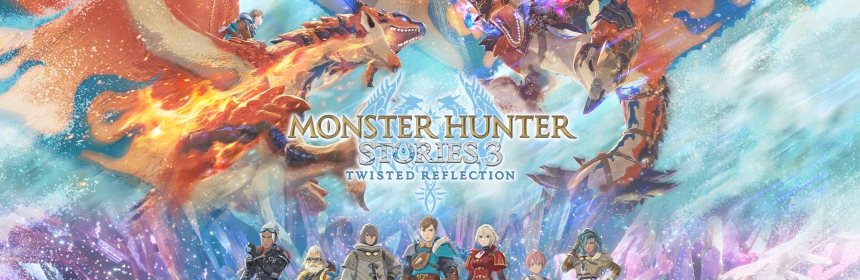
This year I made a promise to myself that I would start trying out some games that aren’t normally in my wheelhouse. Trying to broaden my horizons a bid to appreciate more of the gaming world and have a less closed off mentality to styles I wouldn’t usually immediately go for. That being said, I do really enjoy the Monster Hunter series and I do love RPGs. However, I never really wanted to get into the Monster Hunter Stories titles because it was always described to me as a Pokémon type game, and Pokémon never appealed to me. Now after having played through this, simply describing it as a Pokémon game does a huge disservice to Monster Hunter Stories 3: Twisted Reflection. While it shares some similarities, it is so much more.
Monster Hunter Stories 3: Twisted Reflection has a sprawling and surprisingly deep story. It dives into political issues between the two nations of Azuria and Vermeil, environmental preservations, personal growth with family drama, and bonds between humans and monsters, and how it can go wrong. The protagonist, unnamed but customizable, is the ranger captain and heir to Azuria. With Azuria and Vermeil on the brink of destruction because of a phenomenon called the Crystal Encroachment, you and your rangers are tasked to investigate this deadly infection affecting humans and Monsties.

What mysteries lie in the crystalized city of our dark past?
While your main goal is to figure out the Crystal Encroachment, you’re also responsible for restoring the balance of the Monstie ecosystems. The infection drives the Monsties insane and they start invading other ecosystems becoming a invasive species. You will need to find and take down the invasive Monstie in order to start building back the regions natural Monstie ecosystem. There are four different main regions you will explore: Azuria, Cataracts, Galyad, and the Sacrosanctum. All with their own unique Monsties and uncovering mysterious about yourself, your family, your ancestors, and what started the Crystal Encroachment.
There is a lot of branching stories here, but it doesn’t get lost or bogged down too often and I was intrigued by all the story lines through the entire game. There are quite a lot of side content to do as well with tons of little side missions, but these are mostly pretty simple fetch quests or hunting missions. However, there are some side missions you’ll want to complete because it will give your recipes for new armor, weapons, or food. The real meat of the side content comes from your main companions, and fellow riders. With five different companion quests and each having four chapters there is an extra twenty missions to do, and I consider companion quests as main missions. All of it works very well and ends up being important to the main characters story and personal growth.

These Monsties are only used as weapons for destruction instead of bonding with their rider.
I really appreciate how Monster Hunter Stories 3: Twisted Reflection blends in the gameplay to its overall setting and theme with the characters. As I mentioned above, you play as the ranger captain and the entire point of the rangers, unlike the hunters from the original games, is to preserve the ecosystems. Much like our wild life conservation, we must protect and cultivate ecosystems. It is necessary to harvest Monstie eggs in order to raise them and bolster their regions so they don’t go extinct.
This is done by raiding Monstie dens and snagging one of their eggs and hatching them back in the stables. This is a key mechanic to multiple aspects of the game, which I will get into next. My one issue with the story having such a big focus on conservation and respecting the bonds of Monsties and humans is that it does get a bit contradictory. In typical Monster Hunter fashion the way you craft and level up gear is by using parts of the Monsties you kill.

While the Habitat Restoration is a unique aspect of the gameplay, it is funny that you can still decimate countless Monsties to harvest their parts.
So while the idea and blend of story and gameplay is good, I was preaching that we must protect these Monsties while absolutely decimating so many of them just so I could grind gear and XP. If Monsties didn’t respawn, I would have wiped out more ecosystems than any of the invasive species would have. I get that it’s a game and it still needs to have this, it isn’t a big deal, but it is something I laughed at when looking back.
Let’s get back to the gameplay. Harvesting eggs allows you to hatch specific monsters allowing you to use them in battle. Since you’re a rider, you have the ability to bond with Monsties and use them for exploration and battle. Much like the original series, each Monstie will have different abilities, elements, and attack types. Having a wide selection of Monsties is important not only for battle, but also for exploration. You’re able to ride the Monsties and each one has an ability to get you access around the world. Some fly (really they just kind of glide), others can use breathe attacks to shoot and stun other Monsties, and some can climb walls or even dig into holes to access other areas. Making sure you have a wide variety is the best way to ensure you can explore everything without going back to the stables to change a loadout.

Hatching eggs with more potent rarity grants better skills and stats.
Depending on the level of den you are raiding you will harvest higher ranked eggs which result in Monsties with better inherit stats. You can also use extra Monsties to increase that species rank in that ecosystem further increasing the chances of getting better Monsties. Before you can do that however, you will need to clear out the invasive Monstie first. These are much harder boss like battles that offer a deeper challenge and will require you to plan gear around their weaknesses and elements. They also will change stances way more which means you will need to observe their patterns and behaviors and adapt to that.
The general combat in Monster Hunter Stories 3: Twisted Reflection isn’t all that complicated, but there definitely is a mastery to it. Every character and Monstie has three attack types: Power, Technical, and Speed. These work like a round of Rock-Paper-Scissors with Power>Technical>Speed>Power. It’s simple, easy to learn, but where you need to pay attention is when the Monsties switch between them. It won’t be obvious so you need to pay attention to their attacks and sometimes it a bit of trial and error. When a Monstie locks onto you or your Monstie for a Head-to-Head, you will need to pick the right attack type to best it. You won’t know which one the enemy Monstie will use until its already attacking, then you learn and adapt.

Targeting body parts and weakening Monsties is very important.
Winning a Head-to-Head means you get to negate their attack completely and do high damage to them. If you and your Monstie have the same attack type you can trigger a Double Attack for even more damage. While the player can easily swap between the three attack types, Monsties typically are tied to one until you start getting into the Rite of Channeling, but I’ll get into that later. Luckily you can swap out your Monstie for another in your party before the attack so you can make sure to win Head-to-Heads. Winning these are paramount especially when fighting the harder bosses.
Elements and resistances play a huge part in in combat also, but this is more self explanatory and if you’ve played any RPG you’ll understand this immediately. You need to match your loadout or your Monstie to best take advantage of the enemies weaknesses and have armor bonuses against their element or elements depending on the Monstie. You’ll need to make sure you dial in your equipment for the harder fights, while normal enemies you can take on by just brute forcing and winning Head-to-Heads. That being said, you still always what to aim for weaknesses whenever you can because of stun damage.

Synchronized attacks, especially with weapons, Monsties, and Companions that have the enemies weakness, does huge damage.
The other major aspect of Monster Hunter Stories 3: Twisted Reflection’s combat is breaking Monsties body parts. If you’re a fan of the series you’ll know the deal, but each Monstie will have various body parts you can focus on and each of your weapons will be strong against it. Typically blunt weapons like Hammers and and Hunting Horns will do Blunt damage and you want to focus on the Monsties head. Piercing damage with Bows and the Gun Lance are good for enemies wings or inflated sacks like Paolumu. Slashing weapons like Great Swords and Long Swords are great for tails and legs. Matching the right weapon to the body part increases your damage to that body part for various effects.
Depending on the body part and whether it’s a special area of the Monstie, breaking it will provide different statuses. Normal parts will stun the enemy interrupting their attack for that turn. Toppling and enemy will make them fall over allowing your whole team to do a Synchronized attack for big damage. Transform will break the transformation which is when a Monstie goes into a special attack state. Enfeeble will increase the damage when attacking that part and Wyvernsoul Damage does increase damage to their Wyvernsoul which is crucial for hard fights.

Kinship and Double Kinship Attacks are special powered up moves that do devastating damage.
Wyvernsoul is essentially the monster stamina gauge, some have smaller amounts and other up to three full bars. Breaking the body part that does Wyvernsoul increases how fast you can chip away at that bar allowing you to Topple the enemy. This will be the main focus for most enemies, until your get to a invasive Monstie that is infected by the Crystal Encroachment. Typically you will want to break the crystals as fast as you can because they increase the Monsties attack damage, but if you attack while the Crystal is activated the Monstie will do Backlash damage to you. You will need to break down the defenses and other parts until the Crystal is neutralized, and then focus all your attacks on it.
This is where synchronizing attacks and making sure you really have the best Monstie loadout is important. The feral monsters will often change attack stances and you will need to make sure you have the right Monsties and companions for the job. Another massive part of the game is the Rite of Channeling, and why collecting eggs is important for other Monsties as well. Essentially you can loadout your current Monsties with the skills and attacks other the other Monsties you have collected. Adding multiple types of attacks from other Monsties is a good way to make them well rounded and ready to win any Head-to-Heads.

Like the original series, cooking plays a big role in your combat effectiveness.
Keeping one Monstie on the field is often a good strategy for specific fights and to build your Kinship meter. Kinship is something you build with your Monstie during combat, and when it fills up you can ride your Monstie and do extra damage. This refills your life and stamina as well as letting you do a devastation special attack. If you and your companion character both fill the Kinship meter and hop on your Monstie you can do a dual attack where both of you do a combined special attack and this can decimate enemies as well as drain their Wyvernsoul gauge.
This may seem like a lot, and there are even some things I’m not mentioning in here like crafting items and using buffs and eating meals to help out. However, the systems are added in slowly, and it doesn’t take long to get used to it. As you’re playing it’s more simple than explained and while there are strategies you will need to learn, the core concepts are fairly easy to understand. I enjoyed this turn based combat quite a lot, it’s addictive, and for me it gets rid of the tediousness of the gameplay loop in original Monster Hunter. You don’t need to constantly run after enemies when they flee and try and find them. You can flee a higher level Monstie that got the jump on you, but they don’t flee and hide causing you to have to chase them for fifteen minutes.

Even if the close up texture work, or lack there of, doesn’t impress. The art style and bold colors look great, even on Steam Deck.
Visually, Monster Hunter Stories 3: Twisted Reflection is a beautiful game. The cell shaded art style and its bright and bold colors make every Monstie and region really pop, and it’s a delight to see. There aren’t really any textures with this style, so it can make certain things like the grass look a bit muddy. However, everything else is a pleasure to look at. What is nice with this style is that it looks fantastic even running on lower settings. This means a large RPG like this runs very well on the Steam Deck and that is where I spent most of my time. Although, at times the gameplay loop isn’t always the best for a quick mobile experience. Being able to jump in mobile and still have this beautiful looking game to play at 30fps was great.
On a traditional PC this thing runs flawless and looks amazing. I’m running an i7-12700kf, RTX 5070, and 32gb of DDR5 and its way overkill for this. As I mentioned, the art design looks amazing no matter what, but being able to pump up the draw distance and the culling make it even better. Flying around these regions and seeing all the Monsties roaming around in the distance is a delight. The only thing I do wish is that they made more designs for the dens themselves. Each region is unique and great looking, but they each only have one kind of Monstie den design. It got a bit tiring doing the same run for everything. It doesn’t make sense that all these species have the same den layout.
Sound design is also great, and in traditional fashion of the Monster Hunter series Monster Hunter Stories 3: Twisted Reflection has a fantastic soundtrack. The intense battle music to the lighthearted jingles to the victory chimes all enhance the experience of the game. The voice acting for the most part is well done, however, there are some annoyances with certain characters, but that could also just be me. Some can get a bit annoying, and the repeated lined of dialogue got grating after a while. God forbid you want to explore a bit while on one of the companion missions. They will remind you every thirty seconds that you aren’t going the right way.
As a newcomer to the Monster Hunter Stories series I was absolutely delighted to have enjoyed my time as much as I did. Comparing this to Pokémon isn’t even right. This is what I’ve always wanted Pokémon to be, a deeper RPG with an important story that was a bit more mature in theme. I absolutely loved my time with Monster Hunter Stories 3: Twisted Reflection and there is even more I can go back and do with the ecosystem gameplay. I’m happy I finally decided to give this a chance, because in some way I almost prefer this over the regular Monster Hunter series.
|
Graphics: 9.0 The cell shaded art style with its bright and bold color palette looks delightful. Lack of textures can sometimes make things look muddy, but it allows for a good looking game that also runs well on the Steam Deck. |
Gameplay: 9.0 I nice mix of open world exploration with simple to learn, but deep RPG systems that works really well for the Monster Hunter series. Bonding and building Monstie ecosystems is really engaging. |
|
Sound: 8.5 The soundtrack is superb like most of the other Monster Hunter titles, and the voice acting and general Monstie sound effect are well done. Repeated dialogue while exploring and in combat can get a bit annoying. |
Fun Factor: 9.0 A shockingly great twist to the Monster Hunter formula that feels fresh, but familiar to fans of the series. Great gameplay accompanied by a decent story and companions make this a very enjoyable RPG. |
|
Final Verdict: 9.0
|
|
Monster Hunter Stories 3: Twisted Reflection is available now on PC, Xbox Series X|S, PlayStation 5, and Nintendo Switch 2.
Reviewed on PC with i7-12700k, RTX 5070, 32gb DDR5 Ram, and Steam Deck.
A copy of Monster Hunter Stories 3: Twisted Reflection was provided by the publisher.


